
Affordable Pulmonary Function Testing In Kansas City
Spirometry Testing
Spirometry is a simple, non-invasive breathing test that measures how well your lungs move air in and out. During the test, you'll breathe into a mouthpiece connected to a spirometer, which records how much air you exhale and how quickly. The test itself takes about 10–20 minutes and requires no needles, sedation, or recovery time.
We offer two types of spirometry testing: diagnostic spirometry with bronchodilator response testing, and OSHA-mandated workplace surveillance spirometry. Details on each are below.
Spirometry with Bronchodilator Response
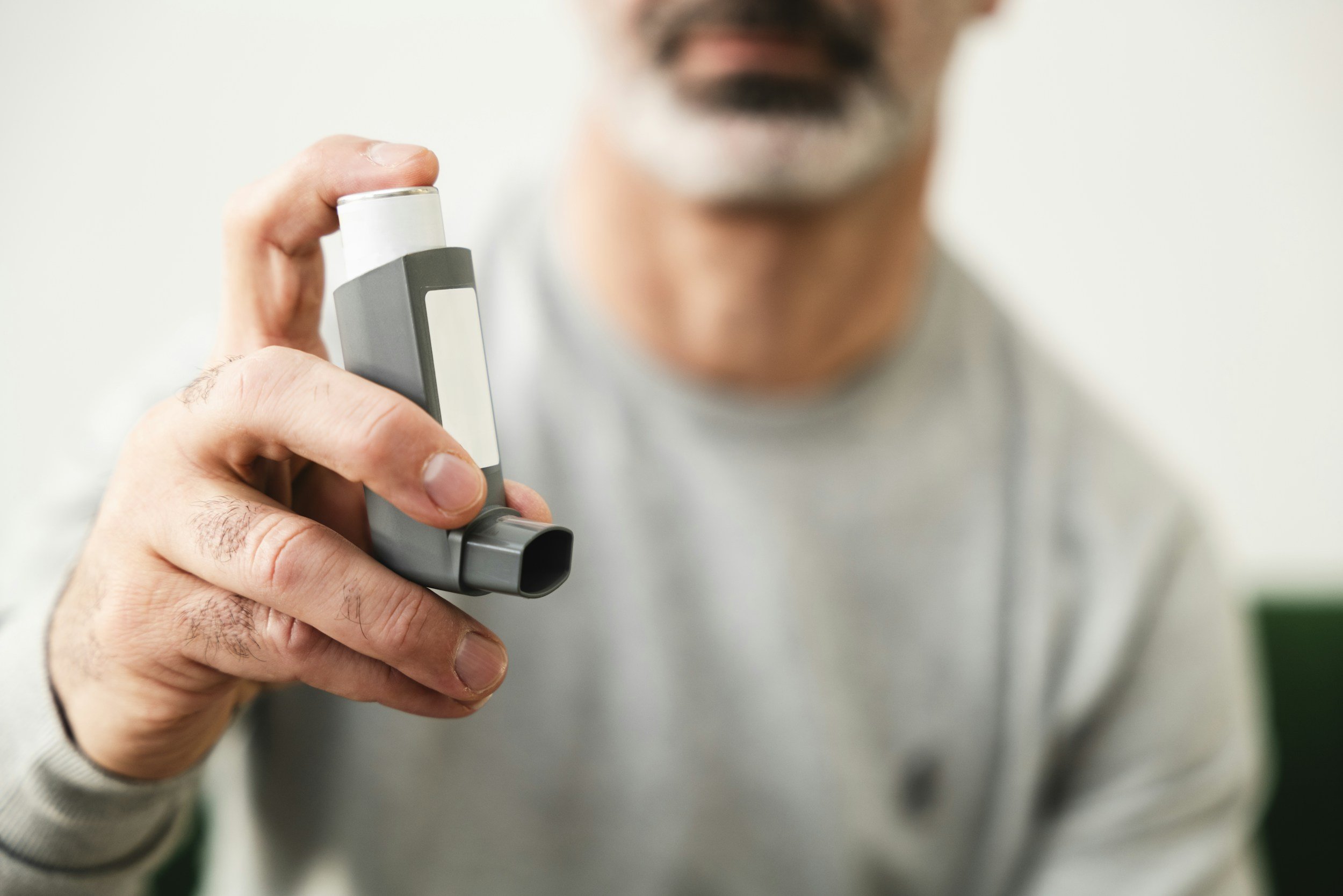
This test measures your lung function before and after using a bronchodilator (a fast-acting inhaled medication that opens the airways). Comparing the two results helps us determine whether airway obstruction is present and whether it improves with treatment — a key step in diagnosing and managing asthma, COPD, and other obstructive lung conditions.
Who this test is for
Anyone experiencing chronic cough, wheezing, chest tightness, or shortness of breath
Patients being evaluated for a possible asthma or COPD diagnosis
Patients with a known lung condition who need to monitor disease progression or treatment response
What to expect
You'll perform an initial round of forced breathing maneuvers to establish a baseline.
You'll be given a dose of a short-acting bronchodilator (typically albuterol) through an inhaler.
You'll wait approximately 15 minutes for the medication to take effect.
You'll repeat the breathing maneuvers so we can measure any change in your airflow.
How to prepare
Hold off on short-acting bronchodilator inhalers for at least 4–6 hours before your appointment, and long-acting inhalers for 12–24 hours, unless your provider tells you otherwise.
Avoid smoking for at least 1 hour before testing.
Skip heavy meals and vigorous exercise in the hours leading up to your test.
Wear loose, comfortable clothing that doesn't restrict deep breathing.
Understanding your results
If your airflow (specifically FEV1) improves significantly after the bronchodilator — generally an increase of 12% or more and at least 200 mL — this supports a diagnosis of reversible airway obstruction, such as asthma.
OSHA Surveillance Spirometry
This spirometry test is performed to meet Occupational Safety and Health Administration (OSHA) medical surveillance requirements for employees exposed to certain workplace respiratory hazards. It establishes a baseline for lung function and tracks changes over time to help detect early signs of occupational lung disease.
Who needs this test
Employees required to wear a respirator as a condition of their job, under OSHA's Respiratory Protection Standard (29 CFR 1910.134)
Workers in industries covered by OSHA standards that mandate spirometry, including those involving cotton dust, silica, asbestos, coke oven emissions, cadmium, and benzene
New employees entering a regulated-exposure role (baseline testing)
Current employees due for periodic follow-up testing, typically on an annual basis
What makes this testing different
Testing is performed by a NIOSH-approved spirometry technician.
All equipment and technique follow ATS/ERS (American Thoracic Society/European Respiratory Society) standards for accuracy and consistency.
Your results are compared against standard predicted values and tracked over time to identify any meaningful decline in lung function.
Records are maintained confidentially in accordance with OSHA recordkeeping requirements.
What to bring
Photo ID
Employer authorization or referral paperwork, if provided
A list of current medications
Prior spirometry results, if you have them, for comparison
What to expect
The testing process is similar to standard spirometry — you'll perform several forced exhalation maneuvers until we obtain three acceptable, reproducible results. Bronchodilator medication is not used for this type of testing.